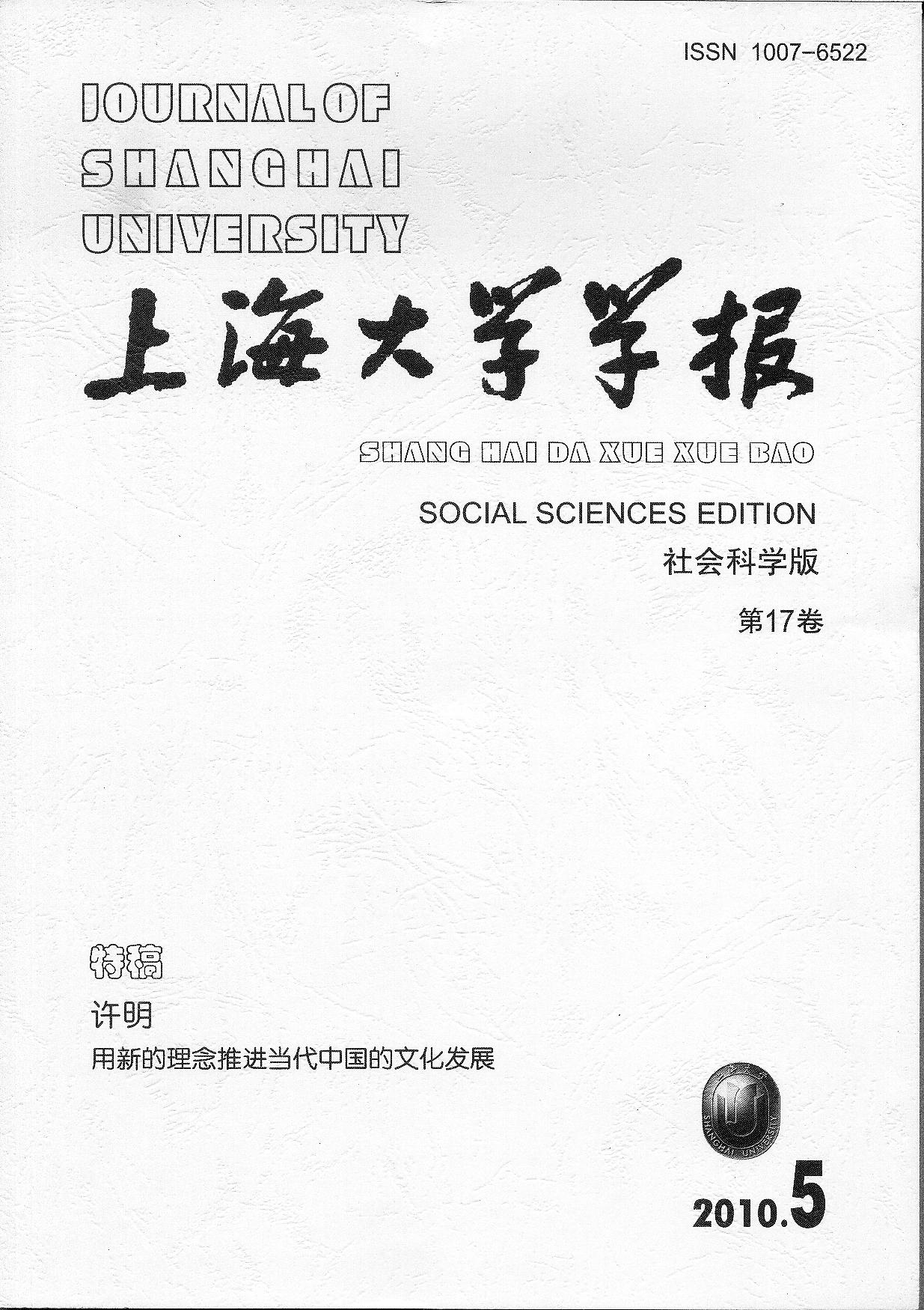
Most Download

    Published in last 1 year | In last 2 years| In last 3 years| All| Most Downloaded in Recent Month | Most Downloaded in Recent Year|

    In last 2 years
    Please wait a minute...
    For Selected: Toggle Thumbnails
    Taste Change in Rural Wedding Ceremonies and the“Urbanite” Imaginations of Rural Youth—A Case Study of P Village in Eastern Henan Province
    ZHANG Dunfu, GAO Xiali
    Journal of Shanghai University (Social Science Edition)    2024, 41 (6): 95-109.  
    Abstract (881)            Save

    In the process of urban-rural integration, rural wedding ceremonies have undergone significant changes in both form and content. Based on semi-structured interviews and observations of villagers in P Village, eastern Henan Province, this study explores the taste change in rural wedding ceremonies. It finds that traditional rural wedding ceremonies aimed at cultural expression integrating form and meaning. However, with increased social mobility, cultural integration, and shifts in consumption patterns, the involvement of wedding planning companies has offered rural youth the opportunity to enhance their aesthetics and achieve self and social identity through the construction of“urbanite”imaginations. In the modernization of rural wedding ceremonies, visual consumption and experience have become central concerns for both hosts and participants. By imitating fashionable urban weddings, rural youth have achieved a superficial satisfaction of their desire for elevated taste. Nevertheless, due to differences in access to cultural capital, the“urbanite”imagination of the rural youth remains incomplete, and the aesthetic taste divide between urban and rural youth, as exemplified by wedding ceremonies, remains difficult to bridge.

    Related Articles | Metrics | Comments(0)
    The Production Tension and Governance of the Cultural Space in Traditional Villages within the Scenes of Cultural Affluence
    LIN Li, SUN Xuan
    Journal of Shanghai University (Social Science Edition)    2024, 41 (6): 110-121.  
    Abstract (1240)            Save

    Abstract:Traditional villages, often regarded as "living fossils" of China's rich traditional culture, possess abundant natural resources. While tourism development generates material wealth, it also leads to the capitalization of space production and poses a crisis to cultural heritage within these villages. The real contradictions between tourism development and cultural protection, along with the material manifestations and spiritual absences under capital dominance, are evident in the landscape, institutional, and spiritual aspects of the cultural space in traditional villages. There is a coexistence of tourism-driven poverty alleviation and destructive spatial exploitation, a pursuit of operational profit alongside antagonistic spatial contention, and a conflict between the monetization of collective memory and the commodification of space. Scene Theory provides a theoretical basis for analyzing the causes of production tension within the cultural space of traditional villages. The aesthetic expression disorder in cultural landscape space, the entropy increase of identity recognition in cultural institutional space, and the value positioning disorder in cultural spiritual space lead to a lack of scene dynamics. To break free from the domination of capital logic and return to the essence of cultural affluence, achieving a true sense of cultural tourism in traditional villages is essential. This can be accomplished by empowering cultural landscape aesthetics with technology, ensuring genuine cultural life through fair institutions, and exploring the value of traditional culture through comprehensive human development, thereby promoting cultural revitalization.

    Related Articles | Metrics | Comments(0)
    Conflicts of Interest in Contracts of Mandate and Their Remedies
    ZHANG Yaping, LI Cun
    Journal of Shanghai University (Social Science Edition)    2024, 41 (6): 122-136.  
    Abstract (1350)            Save

    A contract of mandate, as a model of“acting on behalf of others,”is characterized by a nonadversarial interest structure between the mandator and the mandatary. A conflict of interest arises in a contract of mandate when the mandatary’s personal interests conflict with those of the mandator, resulting in the mandator not achieving the optimal benefits they could have expected. The Civil Code of the People’s Republic of China does not explicitly address conflicts of interest in contracts of mandate, necessitating clarification through legal interpretation. Normatively, conflicts of interest should not be subsumed under the duty of care or the scope of authority. Essentially, a conflict of interest constitutes a breach of the mandatary’s duty of loyalty and should be subject to Article 509, Paragraph 2 of the Civil Code regarding special fiduciary duties, and Article 919 concerning the duty of performance. In terms of legal remedies for conflicts of interest, generally, various levels of remedies such as compensation for losses, termination of the contract of mandate, and refusal to transfer the effectiveness of management actions can be employed. In special circumstances, when the mandatary obtains benefits exceeding the mandator’s actual losses due to a breach of the duty of loyalty, a purposive expansion of Article 927 of the Civil Code should be applied, based on the inhibitory theory of legal policy, to achieve the actual effect of disgorging profits.

    Related Articles | Metrics | Comments(0)
    Exploring Rating Systems for Micro-Dramas and Regulatory Pathways for Their Distribution
    YAN Xingyu
    Journal of Shanghai University (Social Science Edition)    2025, 42 (2): 85-96.  
    Abstract (745)            Save
    Micro drama represents an innovative digital audiovisual format that has evolved from short form videos, incorporating elements of both short-form and long-form content. Recent years have witnessed a significant increase in both production volume and associated challenges, highlighting the necessity for early standardization of production and distribution pathways to foster high-quality development. In response to the challenges posed by high production volume and content review complexities, foreign film and television rating systems offer valuable reference for addressing current regulatory issues in micro-drama. The implementation
    of a rating management system holds practical significance across multiple dimensions: promoting healthy psychological development among minors, accommodating diverse aesthetic preferences across age groups, encouraging creators’individual creativity, establishing sound social values, and ensuring sustainable high quality development of the medium. The proposed practical framework encompasses four classification levels: General Audience, Guidance, Special Guidance, and Restricted. This system operates through a three-stage management approach—pre-production, production, and post-production—effectively regulating target audiences and distribution channels while optimizing traffic allocation and commercial models under the rating
    framework. Such systematic regulation aims to promote both standardization and diversification in micro-drama development.
    Related Articles | Metrics | Comments(0)
    Post-Apocalyptic Speculative Fiction from the Lens of New Materialism
    DU Lanlan
    Journal of Shanghai University (Social Science Edition)    2025, 42 (1): 76-86.  
    Abstract (852)            Save
    As one of the major narrative modes of English climate fiction, post-apocalyptic writing began to flourish in the twenty-first century. Post-apocalyptic speculative fiction, as a literary response to climate change in the Anthropocene, reflects on the dire impacts of Anthropocentrism on humans, non-humans, nature, society, and the Earth, placing increasing emphasis on the entangled relationship between humans and non-humans in the globalized risk society. Taking global climate change and the unequal distribution of resources into consideration, twenty-first-century English speculative fictionists use the dystopian narrative mode to caution readers and emphasize the importance of interdependence among humans and non-humans. This
    article first discusses the three turns of New Materialism and then interprets three post-apocalyptic novels, i.e., Paolo Bacigalupi’s The Windup Girl, Margaret Atwood’s Oryx and Crake and Emily St. John Mandel’s Station Eleven respectively, from the lens of New Materialism to explore the ethical messages conveyed in their envisioning of the future world.
    Related Articles | Metrics | Comments(0)
    From“Teaching Chinese as a Foreign Language”to“Global Development of Chinese Language”: An Examination of the Conceptual
    History of“International Chinese Education”
    HU Fanzhu, GUO Yedan
    Journal of Shanghai University (Social Science Edition)    2025, 42 (2): 124-140.  
    Abstract (1121)            Save
    The large-scale social movement of“promoting Chinese language globally”has evolved in tandem with China’s reform and opening-up policy’s principle of“learning from the world.”Indeed, the genuine international dissemination of Chinese language would not have been possible without authentic reform and opening-up. Language dissemination inherently correlates with human interaction, just as language development intrinsically connects with social progress. Since the 1980s, the field of Chinese language
    education has witnessed remarkable growth, accompanied by a significant evolution in terminology: from “Teaching Chinese as a Foreign Language”to“International Chinese Language Education,”and subsequently to today’s“International Chinese Education.”This progression from foreign to international, and from teaching to education signifies more than mere semantic change—it represents a fundamental conceptual transformation. Nevertheless, considerable ambiguity persists within academic circles regarding the true scope and implications of International Chinese Education. To address this, we must establish two fundamental principles. First, International Chinese Education should be recognized as a form of education that fosters international understanding, conducted on a global scale, with Chinese as its medium and global governance as its guiding principle. Second, we need to develop and embrace the concept of“global development of Chinese language”by moving beyond the traditional focus on teaching and education alone. This approach advocates advancing Chinese language development through global language use, language services, and language knowledge production. This development is pursued through Chinese-foreign collaboration within a framework of global development. The path forward entails a reciprocal relationship where the global development of Chinese
    language and continued reform and opening-up mutually reinforce each other, ultimately contributing to both global development and Chinese language advancement.

    Related Articles | Metrics | Comments(0)
    The International Politics of Constructing Literary History: The Discourse and Academic Value of The Cambridge History of Russian Literature
    LIN Jinghua
    Journal of Shanghai University (Social Science Edition)    2024, 41 (6): 72-94.  
    Abstract (773)            Save

    The collapse of the Soviet Union and the post-Soviet process have shown that the voluminous history of Russian literature compiled by scholars in the Soviet, much like the State itself, was a failure. On the contrary, works of the same type compiled by Slavic scholars in the Cold War era still have academic vitality, and The Cambridge History of Russian Literature (1989) edited by Professor Charles A. Moser at George Washington University is particularly influential. The literary history is pioneering in establishing a literary historical view that understands Russian literature within the context of imperial processes, constructing a framework that acknowledges Russian literature’s development under European cultural influence, and employing methods that recognize Russian literature through the lens of Russian cultural transformation. This kind of literary history, which surpasses the politically correct discourse of the West in the Cold War era, is beyond the scope of scholars in the Soviet limited to the official ideology guiding the compilation of literary history.

    Related Articles | Metrics | Comments(0)
    “Relational Politics”: Concepts, Theories and Its Application in China’s Context
    YE Juanli, SONG Jialin
    Journal of Shanghai University (Social Science Edition)    2024, 41 (6): 1-25.  
    Abstract (897)            Save

    The essence of human nature is the totality of social relations. The study of“relations”forms the foundation of all research in humanities and social sciences, a commonality shared by both Eastern and Western traditions. Theories such as Relational Power Theory, Actor-network Theory, and Social Capital Theory have directly or indirectly addressed the nature, structure, and function of“relations,”suggesting that relations invariably point towards special interests and are closely intertwined with power, resources, and capital. In recent times, however, the context of“relations”has gradually become more China-centric, often being replaced by the concept of“Chinese-style Relations,”particularly in overseas China Studies. Viewing Chinese society through the lens of“relations”reveals their pervasive influence on social hierarchies and realworld political interactions, giving rise to a form of“relational politics.”Nevertheless, a closer examination of Western societies shows that“relations”are equally ubiquitous in both international and domestic politics, with “relational politics”serving as a crucial analytical tool.

    Related Articles | Metrics | Comments(0)
    On the Legal Construction of China’s Green Ports under the Background of“Double Carbon”Goals
    ZHANG Jing
    Journal of Shanghai University (Social Science Edition)    2024, 41 (6): 137-148.  
    Abstract (890)            Save

    From the perspective of social systems theory, the construction of green ports requires balancing the various systems related to ports to achieve a harmonious integration of economic benefits and environmental protection. In China, green ports in a critical transition period have made progress in promoting clean energy applications, supported by a comprehensive, multi-level, and broad-ranging legal framework. However, the construction of green ports in China still faces legal challenges, such as insufficient legal provisions for economic incentives for shore power for ships, incomplete legal systems for regulating port and ship pollutants, and outdated evaluation systems for green port construction. Future efforts should focus on improving the legal system for economic incentives for shore power in green ports by promoting subsidy systems, emphasizing tax incentives, and exploring green financial investment and financing mechanisms. The legal supervision system for ship-source water pollutants in ports should be strengthened by optimizing joint supervision mechanisms and clarifying regulatory authorities for ballast water discharge control. The green port evaluation index system should be perfected by optimizing evaluation indicators and feasibility grading rules, so as to seek new paths of implementation and development for green port construction.

    Related Articles | Metrics | Comments(0)
    Body, Sports View and Construction of National Identity: On Narrative Themes of Chinese Sports Film
    ZHANG Bin, WANG Tianyi
    Journal of Shanghai University (Social Science Edition)    2024, 41 (6): 49-59.  
    Abstract (943)            Save

    In recent years, sports films have sparked widespread media attention and passionate discussions among audiences. In fact, since China began producing sports films in the 1930s, these movies have exhibited diverse facets and shifting narrative focuses across different historical periods and socio-political contexts. The narrative themes in Chinese mainland sports films have undergone a historical transformation, evolving through perspectives of revolutionary sports, people’s sports, humanistic sports, Olympic sports, and rejuvenation sports. This evolution mirrors the development trajectory of China’s sports industry and is closely intertwined with the country’s social transformation, reflecting the intricate connections between the body, sports views, and national development. Consequently, these films have cultivated a unique expression of China’ s distinctive sports culture and spirit, thereby constructing a sense of national identity.

    Related Articles | Metrics | Comments(0)
    The International Image of Chinese Language: Historical Review,Formation Causes, and Reconstruction Strategies
    HUANG Wenjie, HUANG Yerui
    Journal of Shanghai University (Social Science Edition)    2025, 42 (1): 63-75.  
    Abstract (482)            Save
    The formation of the international image of Chinese language is deeply influenced by European Sinology studies. In European sinological literature, Chinese language is depicted as a difficult language to learn, characterized by multiple ontological features such as Chinese characters, phonetics, and grammar. This stereotypical international image of Chinese as a difficult language is inextricably linked to the solidification of the Western understanding of the Chinese knowledge system, the limitations of Chinese international image dissemination, and various historical, social, and political factors. The reconstruction of the international image of the Chinese language in the new era should revolve around four core elements: economic dividends, technological empowerment, cultural appeal, and Chinese identity. Based on the overall improvement of China’s national image and leveraging China’s positive contributions and increasing influence in global governance, the
    reconstruction should address the core demands of international Chinese education, guide learners to experience the unique charm of the Chinese language, construct an academic discourse system for Chinese language research and dissemination, enhance the contribution of the Chinese language to world language research, and expand the application and influence of the Chinese language internationally.
    Related Articles | Metrics | Comments(0)
    Three Sources of Constructing Sublime Aesthetic Discourse in the Research of“Seventeen-Year”Cinema
    REN Huadong, LIU Fan
    Journal of Shanghai University (Social Science Edition)    2025, 42 (2): 33-45.  
    Abstract (438)            Save
    The sublime stands as one of the core aesthetic discourses in contemporary academic research on“Seventeen-Year Cinema”(1949-1966). The semantic generation and discursive practice of the sublime in this context derive from three primary sources: first, the introduction and integration of Western sublime theories with China’s existing sublime discourse and cultural traditions that emphasize ethics and morality; second, the ideological recognition and explicit pursuit of film art’s uniqueness and significance; third, the aesthetic shaping of“generalized heroic imagery”centered on workers, peasants, and soldiers. While Chinese academia inherited the“moral transcendence-pleasure dimension”from both Western theories of the sublime (notably Kant’s) and traditional Chinese aesthetic culture, it significantly diminished the“aesthetic form-pain dimension.”This trend resulted in a“one-dimensional semantic state”marked by an“excess of pleasure”and an“insufficiency of pain,”thereby establishing a significant divergence from the Western conception of the sublime, which is characterized by“dual-dimensional heterogeneity and transformation.”
    Related Articles | Metrics | Comments(0)
    Philosophical Reflections on Three Frontier Issues of Digital Labor
    PANG Yuehui, DING Yi
    Journal of Shanghai University (Social Science Edition)    2025, 42 (2): 97-107.  
    Abstract (435)            Save
    In the modern society, driven by the tremendous advancement of information communication and artificial intelligence technologies, we have entered the digital era, which has triggered significant new transformations in social labor patterns, giving rise to digital labor forms supported by digital platforms. While these new forms of digital labor significantly drive innovations in social life patterns and production modes, they also bring new explicit and implicit contradictions into life and production, necessitating urgent theoretical analysis of digital labor. Grounded in deep insights into the evolutionary trajectory of digital labor, a
    philosophical examination reveals three frontier issues: the manifestation of digital labor subjectivity, the diversification of digital labor values, and the existence of digital labor alienation. The analysis aims to rationally grasp the essential characteristics of digital labor and continuously enhance its optimization effects. The findings contribute significant academic value to deepening theoretical understanding of social labor while carrying profound practical implications for proactively advancing labor innovation and fostering the development of new quality productive forces.
    Related Articles | Metrics | Comments(0)
    Theoretical Reflection and Reconstruction of Data Rights Confirmation
    JI Leilei
    Journal of Shanghai University (Social Science Edition)    2025, 42 (1): 15-29.  
    Abstract (442)            Save
    Exploring the framework of the system of data property rights is the institutional prerequisite for ensuring healthy circulation and transaction of data. Currently, the practical challenges of data rights confirmation are often attributed to the inherent non-exclusivity of data, the limitations of the traditional labor theory-based system, and their conflict with the principles of equitable data utilization. Reflecting on the root causes of these challenges reveals that academia has overlooked the fact that digital society is the foundation for the existence of data value, has confused the intrinsic nature of data rights with their external effects, and has failed to uncover the complex legal attributes underlying the construction of data rights. Tracing the developmental trajectory of original data rights, from the algorithmic identification of data interests to their
    judicial recognition and the technical practices of data rights confirmation, data rights have undergone a procedural transformation from interests to rights, thereby providing a legitimacy basis for data rights confirmation. On this foundation, the composite structure of data determines that data rights should be defined as limited exclusive rights realized through shared utilization. Accordingly, the interconnected design of data rights should be constructed across individual, corporate, and public dimensions.
    Related Articles | Metrics | Comments(0)
    The Cinematic Interpretation of“Sublime Beauty”in the New Era: A Focus on New Mainstream Films
    HUANG Wenjie, HUANG Yerui
    Journal of Shanghai University (Social Science Edition)    2025, 42 (1): 50-62.  
    Abstract (403)            Save
    The concept of the“sublime,”as a fundamental category in aesthetics, has undergone continuous evolution in both content and significance across different historical periods. Within the context of the new era, the manifestation of the“sublime”in new mainstream films reflects the inheritance of a collective- oriented mainstream ideology and a hero-centered aesthetic framework. By integrating fresh feminine experiences and perspectives, upholding a people-centered value system, and embodying an internationalist vision of building a community with a shared future for mankind, this redefined notion of the sublime has emerged as a pivotal theoretical cornerstone in constructing a new aesthetic paradigm for Chinese cinema in the new era.
    Related Articles | Metrics | Comments(0)
    Localization, Autonomy, and Spatiality: Three Orientations of the Aesthetic Practice in Early Shanghai Cinema
    WANG Yinhui, ZHAO Ruiyu
    Journal of Shanghai University (Social Science Edition)    2024, 41 (6): 60-71.  
    Abstract (839)            Save

    Abstract:The aesthetic practice of early Shanghai cinema was primarily manifested in its localization strategies. Firstly, after the introduction of film technology from the West, early Shanghai filmmakers engaged in unique formal explorations and aesthetic practice through material selection, production, and screening. The overall construction and aesthetic orientation were imbued with the essence of traditional culture. Secondly, in the contest with the portrayal of the“other”in Western imagery, the early Shanghai directors consciously assumed the responsibility of constructing autonomous images and successfully created a series of new representations, such as those of farmers, petty urbanites, and women. Lastly, during the transition from hybrid spaces like teahouses to specialized cinemas, the early Shanghai cinema reflected the characteristics of the nation, society, and people in terms of culture, social structure, and psychological state during that unique period. These aspects constitute the three dimensions for examining the aesthetic practice of early Shanghai cinema: distinct localization, autonomy, and spatiality.

    Related Articles | Metrics | Comments(0)
    On the Scope of Mandatory ESG Information Disclosure: A Case Study of Employee Protection Information
    WU Wenfang, SUN Jianlun
    Journal of Shanghai University (Social Science Edition)    2025, 42 (3): 1-17.  
    Abstract (337)            Save

    ESG information disclosure in China has gradually shifted from a voluntary system to a mandatory one. As an important issue requiring urgent discussion, the scope of mandatory disclosure of ESG information should no longer be confined to the vague expression of“localized  ransformation of mainstream standards.”Instead, it is necessary to explore the specific scope from the perspective of the legitimacy basis for mandatory disclosure. The legitimacy of mandating disclosure for employee protection information does not stem directly from stakeholder theory or the Sustainable Development Goals; rather, it lies in meeting the objectives set forth separately by labor law and securities law, both of which aim to protect the rights and interests of workers and investors. Accordingly, the obligation to disclose such information can be understood both as a derivative obligation of the statutory duty to protect workers’rights and interests and as an extension of the information disclosure obligations of listed companies. This not only reflects the need for a more socially integrated mechanism to fulfill legally required worker protections but also broadens and updates the connotations of listed companies’information disclosure obligations. For different types of enterprises, the breadth of disclosure regarding employee protection information varies according to their respective obligations.

    Correspondingly, the scope of disclosure should be limited by the statutory rights and interests of workers and an expanded materiality standard.

    Related Articles | Metrics | Comments(0)
    The Existence of“Linked Domains”in Interconnected Narratives and the Reconstruction of Ethical Consensus
    QU Chunjing, WANG Hetong
    Journal of Shanghai University (Social Science Edition)    2024, 41 (6): 39-48.  
    Abstract (786)            Save

    In the digital age, interconnected narratives based on original stories are becoming increasingly prevalent. Film and television production teams build upon those original stories that have gained audience acclaim by engaging in various forms of interconnected storytelling, such as sequels, interwoven narratives, and cross-media adaptations.“Linked domain”serves as the connection point between the new story and the original, representing the overlapping segments of both stories. This manifests in three primary ways: firstly, the continued use of characters from the original story; secondly, the temporal expansion of an event from the original story; and thirdly, the repeated use of the story’s spatial setting. A purely ethical dimension cannot form a“linked domain.”The multifaceted ethical orientation of interconnected works is primarily governed by the dual forces of audience interest and narrative subject orientation. Interconnected

    Related Articles | Metrics | Comments(0)
    Exploring Marx’s Theory of Alienated Labor and Its Relationship to Ownership
    KOU Yao
    Journal of Shanghai University (Social Science Edition)    2024, 41 (6): 26-38.  
    Abstract (1176)            Save

    In Economic and Philosophical Manuscripts of 1844, Marx elucidates his theory of alienated labor through the lens of private property, viewing communism as the positive abolition of self-alienation. In subsequent works such as The German Ideology, Capital, and its manuscripts, Marx shifts his focus to the historical evolution of labor’s objective and subjective conditions within the division of labor and work processes. By examining the historical relationship between labor and ownership, he further deepens and develops his early theory of alienation. Progressing from ownership systems to property rights, Marx ultimately reveals alienated labor as a product of the complete separation of labor and ownership under the capitalist wage labor system. He indicates that the path to eliminating alienated labor in future social development lies in reconstructing the unity of labor and ownership on the foundation of individual ownership based on social principles.

    Related Articles | Metrics | Comments(0)
    The Conceptual world of Deleuze’s Cinema-Philosophy
    LAN Fan
    Journal of Shanghai University (Social Science Edition)    2025, 42 (1): 30-49.  
    Abstract (639)            Save
    Foucault once jokingly commented on Deleuze’s philosophy by stating that the twentieth century would be known as the“Deleuzian era”. This profound observation stems from the contrast between their philosophical approaches: Foucault’s philosophy is an archaeology of thought, one that views the contemporary through the lens of history, while Deleuze’s philosophy is one of“creating concepts,”approaching the contemporary from the perspective of the future. Humans, unique among all beings on Earth and in the universe, perceive the world through their senses—constantly seeking differences, generating concepts, and escaping established views. For Deleuze, cinema is philosophy, and philosophy is cinema. Through cinema, Deleuze attempts to show us that what matters is not what we know or can verify, but what we believe in and
    whether we still hold onto faith. The true significance of modern cinema lies in the fact that genuine thought is not defined by what is already known, but by what is latent or yet to be thought. Thinking is not about explaining; it is about creating. Here arises the perfect opportunity for modern cinema. Modern cinema, or the time-image, transcends all existing boundaries of thought and opens up for us the infinite possibilities of dismantling the closed“cogito.”In doing so, it allows us to rebuild our faith in the world and in humanity itself, inspiring us to pursue and strive for the freedom of thought. Humanity is both the slave and the master of time. The movement- image fulfills humanity’s dream of preserving the“activity”of action, while the time-image represents an attempt to completely“break free”from the limitations of the physical body, propelling human life toward infinite freedom.
    Related Articles | Metrics | Comments(0)